
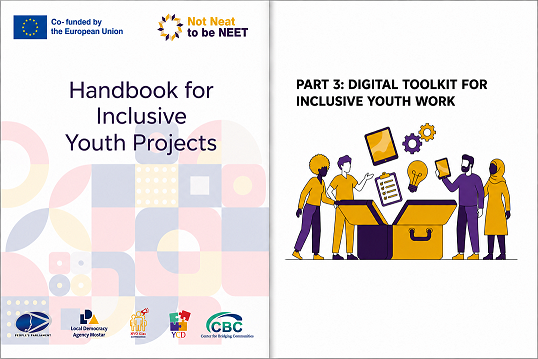
Handbook for Inclusive Youth Projects
The Handbook for Inclusive Youth Projects is a practical open educational resource designed to support youth organizations in integrating inclusion more effectively into their projects and everyday work across the Western Balkans and beyond.
This comprehensive publication was created by Association “People’s Parliament” from Serbia and the “Not Neat to be NEET” consortium partners, the Agency of Local Democracy from Bosnia and Herzegovina, Glas from Montenegro, Center for Bridging Communities from Albania and Drenas Youth Center from Kosovo.
It is the first guide specifically developed to educate and equip Inclusion Coordinators, addressing a significant gap in youth work by providing structured guidance for planning, implementing, and evaluating inclusive youth initiatives.
Developed within the project “Not NEET to be NEET”, the handbook provides a comprehensive collection of practical methods, tools, facilitation techniques and recommendations that enable organizations to strengthen their inclusive practices. One of its key strengths is its high level of transferability. Although the handbook was developed and piloted in the Western Balkans, its methodologies, practical tools, and frameworks are transferable and can be readily adapted to the needs of youth organizations across Europe.
The publication is primarily intended for youth organizations, project managers, trainers, youth workers, and inclusion coordinators who design and deliver educational activities, rather than for young participants themselves. It supports organizations in building internal capacities to plan and manage projects that respond effectively to the diverse needs of young people while promoting equal participation and accessibility.
You can download the handbook by clicking here and in the European SALTO-YOUTH platform
 This project is funded by the European Union. Views and opinions expressed are however those of the author(s) only and do not necessarily reflect those of the European Union or European Education and Culture Executive Agency (EACEA). Neither the European Union nor the EACEA can be held responsible for them.